 Why More and More Industries Must Focus on ESD Protection
1.6.2026
Why More and More Industries Must Focus on ESD Protection
1.6.2026
Electrostatic Discharge (ESD) occurs when accumulated electrostatic charge is suddenly equalized between objects at different electrical potentials. This discharge takes place within milliseconds and often goes completely unnoticed by people.
For electronic components, assemblies, and sensitive systems, however, this brief event can have serious consequences, including complete failure, latent defects, or product malfunctions that may only become apparent once the product reaches the end user.
ESD protection encompasses all measures designed to prevent electrostatic charges from being generated, accumulating, or discharging in an uncontrolled manner.
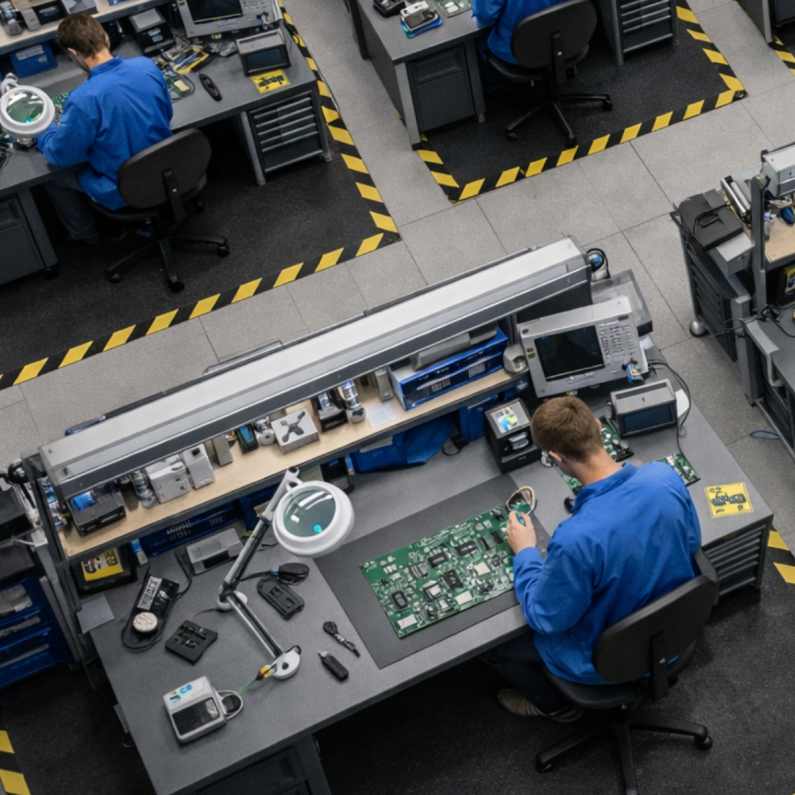
ESD is no longer a niche concern limited to the semiconductor industry. Wherever electronic components are manufactured, assembled, processed, handled, or integrated into products, there is a potential ESD risk.
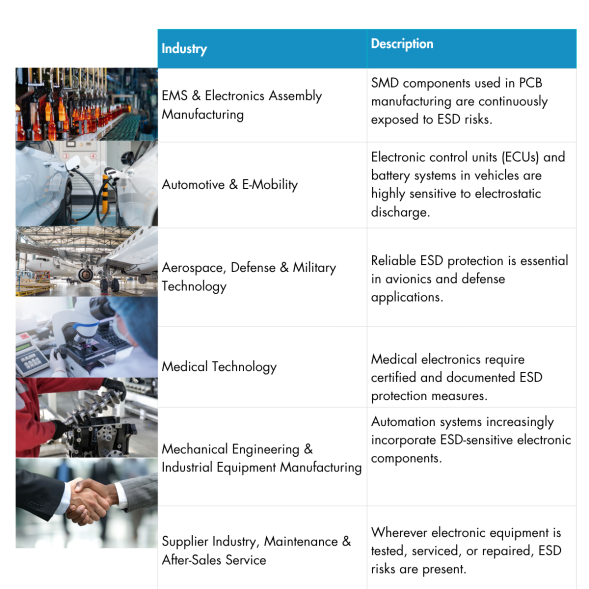
Industries commonly affected include:
As electronic systems become increasingly advanced and miniaturized, effective ESD protection has become an essential requirement for quality, reliability, and compliance across a growing number of industries.
Three key trends are driving the increasing need for ESD protection measures across industries:
Electronic components are becoming smaller, more sensitive, and more valuable. As semiconductor structures continue to shrink, their susceptibility to electrostatic discharge increases significantly.
The growing use of robotics, sensors, and interconnected electronic systems in manufacturing environments creates more potential exposure to ESD-related risks.
Standards such as IEC 61340-5-1 and ANSI/ESD S20.20 are now commonly specified in customer requirements, supplier qualifications, and audit programs. For many manufacturers, compliance is no longer optional—without it, business opportunities may be lost.
ESD protection has evolved into a cross-industry quality requirement, affecting everything from electronics assembly and automotive manufacturing to medical devices and advanced industrial systems.
Organizations that want to remain competitive in modern supply chains need a well-structured, standards-compliant ESD control program that protects products, ensures process reliability, and supports audit and certification requirements.
Entdecken Sie neue Trends und spannende Entwicklungen in unserem Newsletter! Erhalten Sie Expertenwissen regelmäßig in Ihrem Postfach.
Anyone conducting an ESD audit or seeking to verify the effectiveness of an ESD control program will quickly face a crucial question: What kind of measuring[...]
Read moreIn modern electronics manufacturing, the annual inspection of all ESD protection devices in accordance with DIN EN 61340-5-1 is a critical component of quality management; in[...]
Read more
Consistent Soldering Processes Through Precise Analysis
Quality in the soldering process begins in the solder bath.
A stable and defect-free soldering process is crucial to the reliability of[...]
Why the sparktrap® EPA SafeAssure® Is Replacing Traditional Resistance Meters
Industrial laundry service providers bear a great deal of responsibility: Leading industrial companies rely on their ESD[...]
The True Cost of Manual Inspection Routines in Electronics Manufacturing
In modern manufacturing environments characterized by a wide variety of product variants and small batch sizes, as[...]