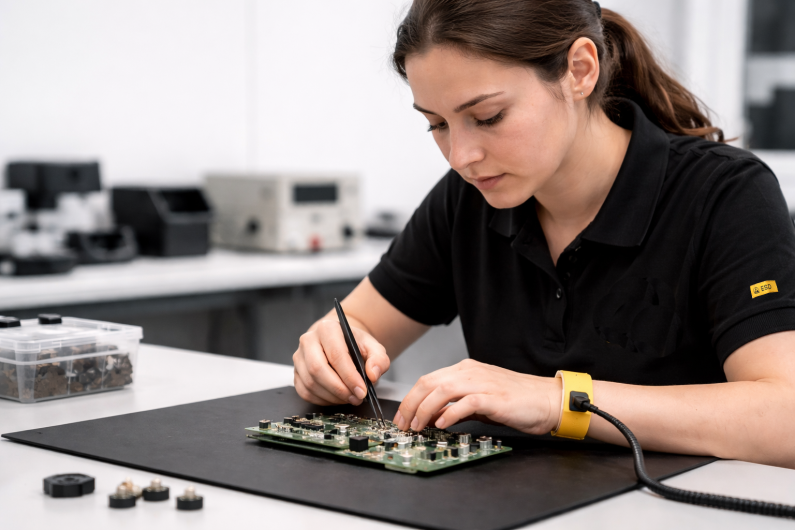
 Step by Step to a Safe ESD Workstation
17.4.2026
Step by Step to a Safe ESD Workstation
17.4.2026
An effective ESD workstation does not happen by chance. It is the result of a well-designed combination of appropriate equipment, clearly defined processes, and regular, standards-compliant verification. But what does such a workstation look like in practice? And what really matters in day-to-day operations?
In this article, we will show you step by step how to set up a safe ESD workstation and how to verify its effectiveness reliably.
An ESD workstation must comply with the requirements of applicable standards (e.g., IEC 61340-5-1). The objective is to prevent electrostatic charge generation wherever possible and to dissipate unavoidable charges in a controlled manner.
A key principle is that safety is not achieved through individual measures alone, but through the interaction of all components within the ESD control system.
A standards-compliant workstation should always be considered part of a comprehensive ESD control program.
Grounding is the fundamental basis of any effective ESD protection system. Ideally, all workstation components form one integrated system in which:
In addition to grounding, workstation equipment plays a critical role in ensuring both safety and practical usability.
Typical equipment includes:
The objective is to control and secure every point of contact with ESD-sensitive components.
Technology alone is not enough. Effective ESD protection depends heavily on the behavior and awareness of employees.
Regular training is therefore essential:
Only when everyone involved understands the system can it function reliably over the long term.
An ESD workstation can only be considered safe when its performance has been verified and documented.
Typical tests include:
A critical point to remember: an ESD workstation remains safe only if it is continuously monitored and verified.
In practice, ESD measurements are often time-consuming and prone to errors, which can result in inconsistent testing. This is where modern ESD test equipment provides significant advantages.
With an ESD multimeter, key measurements can be:
This not only reduces effort but also improves process reliability and compliance.
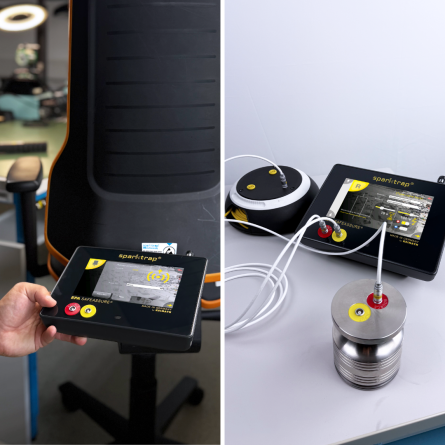
Modern instruments such as the EPA SafeAssure ESD Multimeter combine multiple measurement functions in a single system.
A major advantage is the integrated evaluation of measurement results.
Instead of simply recording data, the system automatically interprets values according to applicable standards.
In addition, modern systems provide:
EPA SafeAssure enables fast, reliable, and audit-ready verification of your entire ESD Protected Area (EPA).
Entdecken Sie neue Trends und spannende Entwicklungen in unserem Newsletter! Erhalten Sie Expertenwissen regelmäßig in Ihrem Postfach.
Anyone conducting an ESD audit or seeking to verify the effectiveness of an ESD control program will quickly face a crucial question: What kind of measuring[...]
Read moreIn modern electronics manufacturing, the annual inspection of all ESD protection devices in accordance with DIN EN 61340-5-1 is a critical component of quality management; in[...]
Read more
Consistent Soldering Processes Through Precise Analysis
Quality in the soldering process begins in the solder bath.
A stable and defect-free soldering process is crucial to the reliability of[...]
Why the sparktrap® EPA SafeAssure® Is Replacing Traditional Resistance Meters
Industrial laundry service providers bear a great deal of responsibility: Leading industrial companies rely on their ESD[...]
The True Cost of Manual Inspection Routines in Electronics Manufacturing
In modern manufacturing environments characterized by a wide variety of product variants and small batch sizes, as[...]