 How Are Electrostatic Charges Generated?
28.5.2026
How Are Electrostatic Charges Generated?
28.5.2026
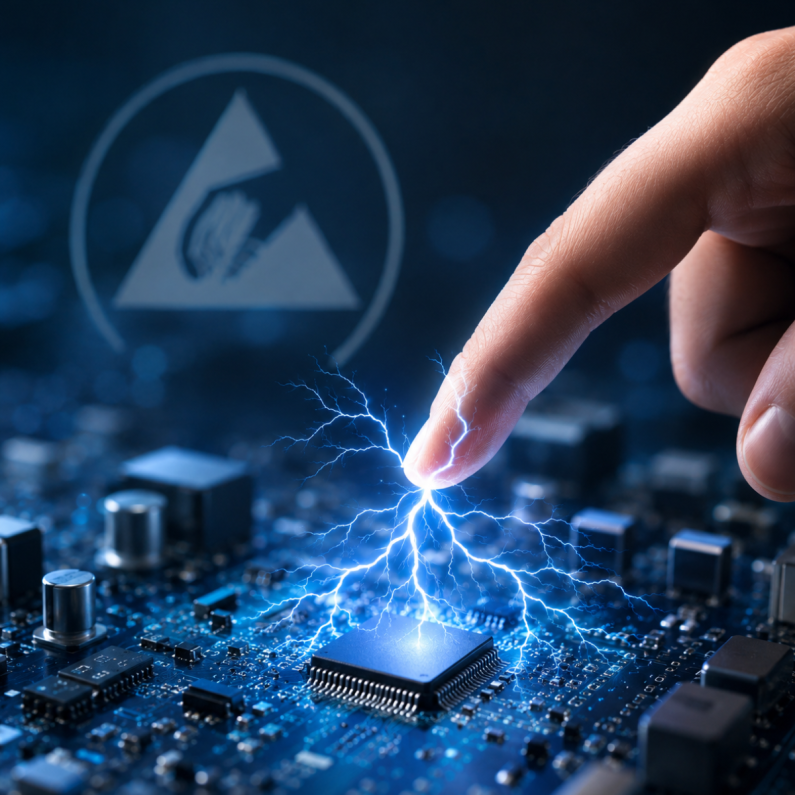
Electrostatic charges are part of our everyday lives, often without us even noticing. The small shock when touching a car door, the crackling sound when taking off a sweater, or hair becoming charged after removing a hat are all common examples. While these effects are usually harmless for people, they can have serious consequences in electronics manufacturing. Even very small electrostatic discharges (ESD – Electrostatic Discharge) can permanently damage sensitive electronic components.
As modern electronics continue to become smaller and semiconductor structures increasingly sensitive, ESD protection has become a critical topic across many industries.
An electrostatic charge is a stationary electrical charge that is generated when materials come into contact and are subsequently separated.
This process occurs in virtually every working environment:
The risk becomes particularly significant wherever electronic assemblies or ESD-sensitive devices (ESDS) are handled.
For a material to become electrostatically charged, electrical charges must first be separated. This occurs when two materials come into contact and are then separated again.
During contact between two different materials, electrons may transfer from one material to the other. Several factors influence this process, including:
As a result, one material becomes positively charged while the other becomes negatively charged. This creates a potential difference, or electrical voltage.
Whether a charge remains on a surface or is dissipated immediately depends largely on the electrical conductivity of the materials involved.
Conductive materials allow charges to dissipate quickly, whereas insulating materials can retain charges for extended periods.
Humans typically do not feel an electrostatic discharge until voltages reach several thousand volts. Modern semiconductor devices, however, can be damaged by only a few hundred volts—or even significantly less.
The ongoing development of modern electronics continues to produce smaller, more powerful, and more densely integrated components.
As device structures become increasingly miniaturized, their sensitivity to electrostatic discharge rises dramatically. This makes effective ESD control more important than ever before.
Our practical ESD training courses and technical seminars provide comprehensive knowledge on all aspects of ESD control—from fundamental principles to hands-on measurement techniques and testing procedures.
Entdecken Sie neue Trends und spannende Entwicklungen in unserem Newsletter! Erhalten Sie Expertenwissen regelmäßig in Ihrem Postfach.
Anyone conducting an ESD audit or seeking to verify the effectiveness of an ESD control program will quickly face a crucial question: What kind of measuring[...]
Read moreIn modern electronics manufacturing, the annual inspection of all ESD protection devices in accordance with DIN EN 61340-5-1 is a critical component of quality management; in[...]
Read more
Consistent Soldering Processes Through Precise Analysis
Quality in the soldering process begins in the solder bath.
A stable and defect-free soldering process is crucial to the reliability of[...]
Why the sparktrap® EPA SafeAssure® Is Replacing Traditional Resistance Meters
Industrial laundry service providers bear a great deal of responsibility: Leading industrial companies rely on their ESD[...]
The True Cost of Manual Inspection Routines in Electronics Manufacturing
In modern manufacturing environments characterized by a wide variety of product variants and small batch sizes, as[...]