 Future Readiness in der EPA
6.7.2026
Future Readiness in der EPA
6.7.2026
Paperwork during an ESD audit? Discover how digital asset tracking and automatic compliance checks make ESD protection ready for Industry 4.0.
In modern electronics manufacturing, everything revolves around innovation: high-tech components are becoming increasingly compact, manufacturing processes are getting smarter, and robots are taking on high-precision tasks. In short, the industry is moving toward the future at the speed of light.
But a closer look at quality assurance practices often reveals a paradoxical picture: While cutting-edge technological products are being manufactured on the factory floor, the corresponding ESD measurement technology in many places is stuck in the last century. ESD audits are still conducted using clipboards, Excel spreadsheets, and a confusing array of outdated measuring devices.
Anyone who wants to keep pace with a digitally driven future and remain competitive cannot simply react when mistakes happen. It is essential to actively design processes to be future-proof. This also means that ESD protection in the EPA (Electrostatic Protected Area) must finally become smart.
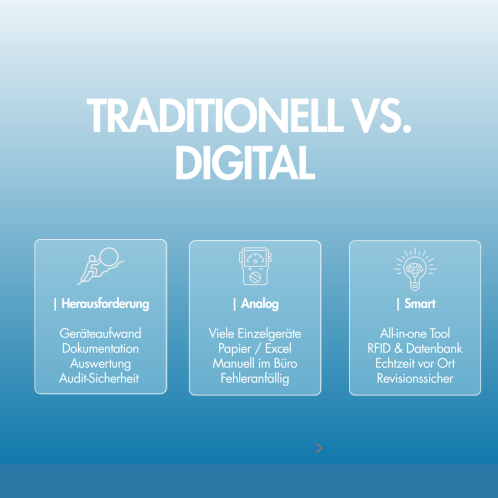
Companies that still document and manage their ESD protection measures manually face the same challenges every day:
The clutter of devices and cables: Different devices are required for various measurements—from walk-through tests to teraohmmeters to charged-plate monitors. This results in setup times and potential sources of error.
Lack of traceability: Handwritten notes or manually maintained Excel spreadsheets are prone to errors, difficult to search, and not 100% audit-proof in the event of an emergency.
Time-consuming compliance checking: Measurement values must be painstakingly compared with the current limit values specified in DIN EN IEC 61340-5-1. This takes up valuable time in quality management.
To meet the demands of modern supply chains and rigorous audits, a seamless, digital, and—above all—efficient quality assurance system is required. This is precisely where the generational shift in measurement technology comes into play.
Efficiency is achieved by reducing complexity. Modern measurement technology combines all relevant ESD measurement methods into a single system. Whether it’s surface resistance according to DIN EN 61340-2-3, walk-on testing according to DIN EN IEC 61340-4-5, or the testing of ESD clothing—a single tool replaces the entire fleet of equipment. This saves time during the measurement process and minimizes the training required for employees.
Future-proofing means making data usable. By integrating RFID technology, every piece of equipment (every table, every chair, every mat) at the EPA is assigned a unique digital identity. The measuring device scans the asset, automatically assigns the measurement value, and stores the history directly in a database—without any additional, complicated software. The result is a complete, auditable ESD control program plan at the push of a button.
No one should have to pore over reference tables anymore to see if a value falls within the tolerance range. Depending on the measurement task, the ESD multimeter automatically applies the appropriate evaluation model. The tester immediately sees a clear result on-site confirming compliance with the standard.
The future is not a state of affairs to be waited for, but a process to be actively shaped. Modern, digital ESD protection not only ensures the quality of highly sensitive electronic components, but also saves countless hours of work in quality management and provides complete peace of mind during the next audit.
Would you like to make your EPA ready for the future?
With the EPA SafeAssure, we have developed the world’s first ESD multimeter that brings this very digital transformation to your manufacturing operations. Learn more now about this game-changer in ESD measurement technology.
Entdecken Sie neue Trends und spannende Entwicklungen in unserem Newsletter! Erhalten Sie Expertenwissen regelmäßig in Ihrem Postfach.
Anyone conducting an ESD audit or seeking to verify the effectiveness of an ESD control program will quickly face a crucial question: What kind of measuring[...]
Read moreIn modern electronics manufacturing, the annual inspection of all ESD protection devices in accordance with DIN EN 61340-5-1 is a critical component of quality management; in[...]
Read more
Consistent Soldering Processes Through Precise Analysis
Quality in the soldering process begins in the solder bath.
A stable and defect-free soldering process is crucial to the reliability of[...]
Why the sparktrap® EPA SafeAssure® Is Replacing Traditional Resistance Meters
Industrial laundry service providers bear a great deal of responsibility: Leading industrial companies rely on their ESD[...]
The True Cost of Manual Inspection Routines in Electronics Manufacturing
In modern manufacturing environments characterized by a wide variety of product variants and small batch sizes, as[...]