 “ESD Measurement Technology Reimagined: What Modern ESD Tests Must Achieve Today”
29.9.2026
“ESD Measurement Technology Reimagined: What Modern ESD Tests Must Achieve Today”
29.9.2026
A New Approach to ESD Measurement Technology: From Precise Individual Measurements to Structured and Traceable Testing
ESD protection is an integral part of quality assurance in many companies. Whenever components susceptible to electrostatic discharge are processed, assembled, or tested, protective measures must not only be implemented but also regularly reviewed and documented. At the same time, the demands placed on the measurement technology used are also increasing. Because the crucial question today is no longer just:
"What reading will I get?"
But increasingly also:
"How was the measurement taken, what was tested, and how can I clearly verify the result later?"
Modern ESD measurement technology must therefore do more than simply record a measurement value.
Anyone who regularly performs testing within an ESD protection area (EPA) is familiar with the wide variety of measurement tasks involved. Work surfaces, floors, shelves, transport carts, containers, clothing, or other ESD-protective items must be tested using the appropriate measurement methods, depending on their function. In addition, there are, for example, measurements of electrostatic fields or walking tests. For quality assurance managers, ESD coordinators, and technicians, this means that they must be fully proficient in a variety of measurement tasks, measurement parameters, electrodes, and test procedures. The measuring device is a key component of the entire testing process.
Reliable measurement results continue to form the basis of every ESD test. At the same time, professional measurement technology should interfere as little as possible with the user’s daily work. It must be possible to select measurement parameters quickly, read measurement values clearly, and perform various measurement tasks easily. It is especially during extensive audits within an EPA that the importance of intuitive operation becomes clear.
Professional measurement technology should combine precision with ease of use.
A single measurement has only limited significance if it is no longer possible to determine under what conditions it was taken.
Modern ESD measurement technology should therefore allow measured values to be linked directly to the relevant information. This reduces the amount of documentation work required afterward and, at the same time, improves the traceability of the audit.
Many ESD tests are not one-time tasks. Workstations, floors, shelves, conveyors, and other elements of an EPA are regularly re-inspected. In practice, this quickly results in a large number of recurring measurements. There is significant potential here for digital measurement technology. Once assets have been clearly documented and the corresponding measurement specifications defined, the user can be guided through the inspection process in a structured manner during a repeat inspection.
Instead of having to specify it again for each test, What needs to be measured and how, a reproducible testing process is available. This not only makes day-to-day work easier, but also helps ensure consistent quality in the exams.
In many companies, the work doesn't end with the measurement. Results must be transferred, assigned to measurement points, tables maintained, and test reports generated. If measurement and documentation are performed separately, this results in additional steps and potential data transfer errors. Modern ESD measurement technology can significantly simplify this process.
If measurement values are recorded digitally during the inspection and assigned to the corresponding measurement points or assets, the documentation is generated directly from the inspection process.
Measuring and documenting become part of a single, integrated workflow.
When it comes to quality assurance, it's not just the current result that counts. Especially when it comes to recurring audits, it is helpful to be able to track the development of an asset over a longer period of time.
A structured measurement history provides transparency and makes it easier to prepare for both internal and external audits. As a result, the measuring device is evolving from a mere testing instrument into a tool for ESD quality management.
In an EPA, various physical parameters and protective elements must be evaluated. Accordingly, several measuring instruments and accessories are used.
A modern solution should therefore cover as many ESD measurement tasks as possible within a coordinated system.
These include, among other things:
Resistance Measurements
Measurements of Electrostatic Fields
Walking Tests
Inspection of ESD Clothing
Measurements Using Different Electrodes
Charge-plate measurements for evaluating ionization systems
Structured recording and documentation of measurement results
The better the hardware, accessories, and software work together, the more efficiently the entire testing process can be organized.
This is exactly where a new generation of ESD measurement technology comes in.
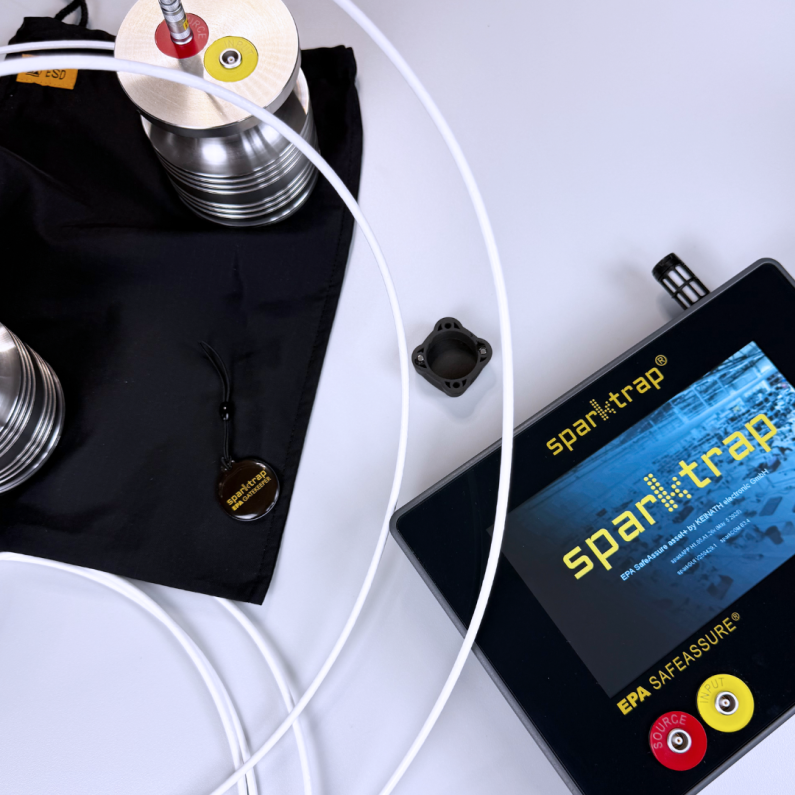
With sparktrap® EPA SafeAssure® At KEINATH Electronic, we have developed a measurement system that combines traditional ESD measurement technology with digital testing and documentation processes.
At the heart of the system is a high-performance high-resistance meter serving as the central measuring unit. It is complemented by a 7-inch touchscreen display, a modular electrode design, a wireless field mill, and functions for various ESD testing tasks. Users can generally choose between two modes of operation:
Measure quickly and easily:
Select the measurement parameters, perform the measurement, record the result, and, if necessary, add information about the measurement point or setup.
Structured and asset-based auditing:
Unambiguously record assets, define measurement specifications, and guide the user step by step through recurring inspections.
This is how individual measurement values are used to create a transparent testing process.
What would it be like if ESD measurement technology didn't just measure, but also supported the entire testing process?
That's exactly what we at October 6–8, 2026, at EFX in Stuttgart.
Visitors can sparktrap® EPA SafeAssure® – the world's first ESD multimeter – experience it firsthand and get a firsthand look at the various measurement and testing options.
Our team will demonstrate on-site how both traditional individual measurements and structured, recurring inspections can be carried out using an intelligent measurement system.
EFX 2026 Messe Stuttgart
Entdecken Sie neue Trends und spannende Entwicklungen in unserem Newsletter! Erhalten Sie Expertenwissen regelmäßig in Ihrem Postfach.
Anyone conducting an ESD audit or seeking to verify the effectiveness of an ESD control program will quickly face a crucial question: What kind of measuring[...]
Read moreIn modern electronics manufacturing, the annual inspection of all ESD protection devices in accordance with DIN EN 61340-5-1 is a critical component of quality management; in[...]
Read more
Consistent Soldering Processes Through Precise Analysis
Quality in the soldering process begins in the solder bath.
A stable and defect-free soldering process is crucial to the reliability of[...]
Why the sparktrap® EPA SafeAssure® Is Replacing Traditional Resistance Meters
Industrial laundry service providers bear a great deal of responsibility: Leading industrial companies rely on their ESD[...]
The True Cost of Manual Inspection Routines in Electronics Manufacturing
In modern manufacturing environments characterized by a wide variety of product variants and small batch sizes, as[...]