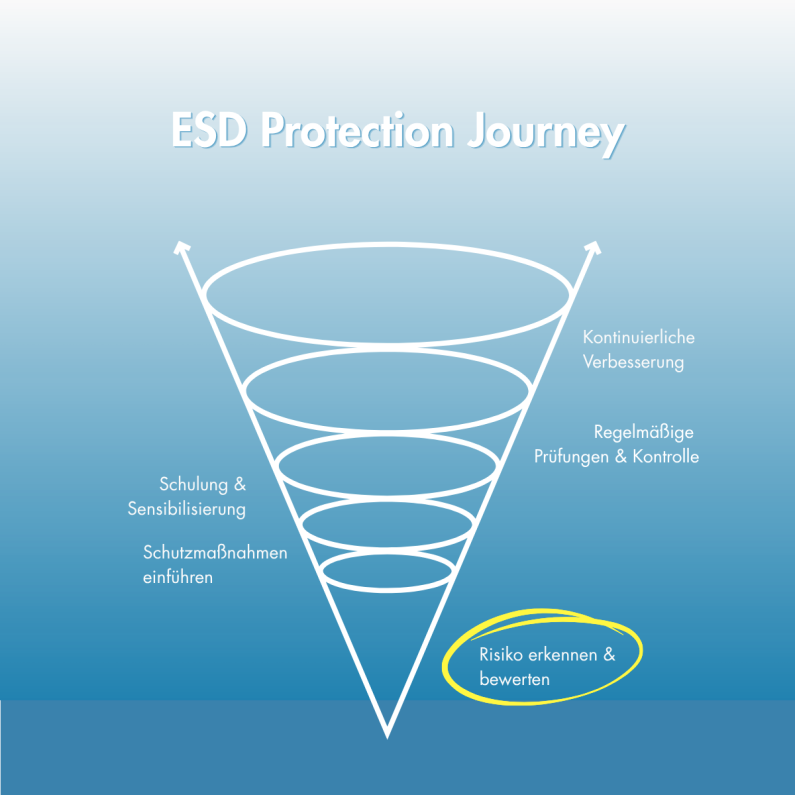
 ESD Protection Journey
24.3.2026
ESD Protection Journey
24.3.2026
In many disciplines, structured development models are already well established. Whether in marketing, sales, or lean management, complex topics are often visualized through funnels, pyramids, or maturity models that describe a journey from initial awareness to continuous improvement.
But what about ESD protection?
In practice, we often encounter a different reality: isolated measures, individual investments, and a lack of overall system thinking. This is exactly where the concept of the “ESD Protection Journey” comes into play.
The key shift in perspective is simple but powerful:
ESD protection is not a state.
ESD protection is a continuous development process.
Rather than focusing on individual protective measures, ESD control should be understood as a maturity model that develops step by step over time.
“We have a risk.”
Every effective ESD control program begins with awareness.
Organizations first recognize that ESD is not merely a theoretical concern but a genuine risk to electronic components, product quality, and operational reliability.
Typical questions at this stage include:
Without awareness, there is rarely a sustainable commitment to ESD protection.
Building Understanding and Changing Behavior
ESD protection only works when people understand its importance.
This stage focuses on:
Technology alone cannot ensure ESD protection. Knowledge and awareness remain essential.
Implementing Protective Measures Systematically
Once awareness and understanding have been established, organizations can begin implementing practical ESD control measures, including:
The goal is not to deploy individual products but to create a fully functional ESD control system.
Making ESD Protection Measurable
An implemented ESD control system is only effective if its performance is regularly verified.
This stage includes:
Monitoring transforms ESD protection from assumption into measurable performance.
Embedding ESD into Organizational Culture
At the highest level of maturity, ESD protection is no longer viewed as a separate initiative. It becomes an integral part of the organization's quality and operational culture.
Characteristics of this stage include:
ESD protection becomes a permanent element of continuous improvement.
Many organizations attempt to start directly with protective measures (Stage 3).
This often leads to:
The reason is simple: the foundational stages were skipped.
An effective ESD control program is not created through individual measures—it is built through structure, understanding, and continuous development.
Why does this model work so well?
Because similar approaches have already proven successful in other areas:
ESD protection follows the same logic.
The ESD Protection Journey provides a structured framework that makes ESD maturity visible, understandable, and actionable.
Whether you are just beginning your ESD journey or looking to optimize an existing ESD control program, our experts can help you assess your current maturity level and identify the next steps toward a more effective and sustainable ESD protection strategy.
Entdecken Sie neue Trends und spannende Entwicklungen in unserem Newsletter! Erhalten Sie Expertenwissen regelmäßig in Ihrem Postfach.
Anyone conducting an ESD audit or seeking to verify the effectiveness of an ESD control program will quickly face a crucial question: What kind of measuring[...]
Read moreIn modern electronics manufacturing, the annual inspection of all ESD protection devices in accordance with DIN EN 61340-5-1 is a critical component of quality management; in[...]
Read more
Consistent Soldering Processes Through Precise Analysis
Quality in the soldering process begins in the solder bath.
A stable and defect-free soldering process is crucial to the reliability of[...]
Why the sparktrap® EPA SafeAssure® Is Replacing Traditional Resistance Meters
Industrial laundry service providers bear a great deal of responsibility: Leading industrial companies rely on their ESD[...]
The True Cost of Manual Inspection Routines in Electronics Manufacturing
In modern manufacturing environments characterized by a wide variety of product variants and small batch sizes, as[...]